
Posted by Herits Food Machinery on 19th Oct 2026
Planetary vs spiral mixers: how to choose the right commercial mixer
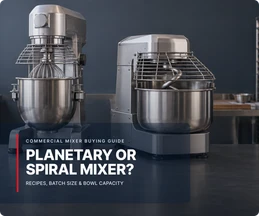
Choose a planetary mixer when one machine needs to handle several jobs, such as cake batter, fillings and whipped cream, with dough mixing within its stated limits. Choose a spiral mixer when bread or pizza dough is the main job and the machine's rated batch range suits your recipes.
For a bakery producing both bread and pastries, the answer may be two machines. The useful starting point is your menu and actual batch weights. Bowl size on its own will not tell you whether a mixer is right for the work.
Planetary or spiral: the quick comparison
| What you need | Planetary mixer | Spiral mixer |
|---|---|---|
| Several preparation jobs | Interchangeable tools make it useful for mixing, beating and whipping | Primarily a dough-mixing choice |
| Bread or pizza dough | Can be suitable with the correct hook, recipe and capacity rating | A strong candidate for a dough-focused operation |
| Cakes, fillings and cream | Check the supplied paddle and whisk | Do not assume it replaces a planetary mixer for these jobs |
| Small and large batches | Check recipe-specific limits and any approved smaller-bowl kit | Check the stated minimum and maximum dough load |
| Removing the mixture | Removable bowls are common; confirm the exact arrangement | Fixed and removable-bowl designs exist |
Sammic's planetary mixer range shows the different mixing tools and smaller-bowl options. Its spiral mixer range distinguishes fixed and removable bowls and publishes batch ranges. Those details matter more than the machine's category alone.
Start with the recipes you make every week
Write down your three most important mixing jobs. For each one, record the recipe, total batch weight, frequency and the time available before the next preparation task.
A café making sponge cakes, buttercream and occasional dough has a different requirement from a pizzeria preparing several dough batches before service. The café should investigate a planetary machine's tools and recipe ratings. The pizzeria should investigate a dough mixer's batch range and how it fits the preparation schedule.
If bread dough occupies the mixer when another member of staff needs to whip cream, buying a bigger bowl may leave the same scheduling problem. Consider whether separate machines would remove that bottleneck before spending more on one larger model.
Sammic's comparison of planetary and spiral mixers explains why a mixed-product bakery may use either type or both. For the rest of your equipment plan, see our guide to starting a bakery.
Understand capacity: litres, flour weight and dough weight
These are three different measurements:
- Bowl capacity in litres describes the bowl's volume.
- Flour capacity in kilograms describes a stated flour load, usually with specified recipe conditions.
- Dough or batch capacity in kilograms describes the total load, including the other ingredients.
Do not read “20 litre” as “20 kg of dough”. Ask for the manufacturer's capacity information for the exact model and the type of mixture you intend to make.
For a concrete example, Sammic's published BP-20 planetary specifications list a 20 litre bowl and 6 kg of flour at 50% water. Its AM(E)-20 spiral specifications list a 22 litre bowl, 10 kg of flour at 50% water, and a separate 4–16 kg capacity per operation. These are manufacturer examples of different ratings; they are not claims about HERITS stock or a guarantee that either machine suits your recipe. BP planetary specifications, AM spiral specifications.
Compare the limits that relate to your mixture. Two machines with similar bowl volumes can have different working capacities.
Why dough hydration changes the decision
For a simple flour-and-water recipe, hydration is the water weight divided by the flour weight, expressed as a percentage. A recipe with 6 kg of flour and 3.6 kg of water has 60% hydration.
Dough recipes also differ in ingredients and mixing requirements. Hobart's capacity guidance for its Legacy+ mixers explains that lower absorption ratios make dough tougher to mix and reduce the maximum capacity for those dough types. Its calculation considers the wet and dry ingredients, rather than treating every recipe as flour and water alone.
The practical lesson is to check your actual recipe against the relevant capacity chart. Do not carry a rating for one dough across to a stiffer recipe, or assume the stated limit applies at every speed and mixing time. Hobart's bowl-size and capacity guidance also explains why recipe conditions belong in the sizing decision.
Worked example: preparing 40 pizza dough balls
Suppose a pizzeria wants 40 dough balls at 250 g each in one preparation batch.
| Planning step | Calculation | Result |
|---|---|---|
| Total dough required | 40 × 250 g | 10,000 g, or 10 kg |
| Flour in a simplified 60% hydration mixture | 10 kg ÷ 1.60 | 6.25 kg |
| Water in that simplified mixture | 6.25 kg × 0.60 | 3.75 kg |
This is a sizing illustration, not a pizza recipe. It ignores salt, yeast, oil, losses and any other ingredients. Recalculate with your real formula and required portion yield.
For the shortlist, you now have useful information: approximately 10 kg of mixture per batch, its actual ingredient weights and the preparation deadline. Ask whether each exact machine is rated for that load and recipe, using the required tool and permitted settings.
Then check the quiet day. If you only need 12 dough balls at the same portion weight, the simplified requirement is 3 kg of dough. A machine with a 4 kg stated minimum batch would need a different production plan or a different model. Maximum capacity is only half the buying decision.
Will it handle your smallest batches?
Oversizing can leave you with a machine that does not suit small preparation jobs. Confirm the minimum useful quantity for the recipes you make, rather than buying solely for an occasional peak.
For planetary mixers, check whether the manufacturer offers an approved smaller bowl and matching tools. Hobart UK lists bowl adaptors for its HSM range and a 10 litre adaptor kit for the 20 litre A200. Those options are model-specific; a smaller bowl or attachment from another machine is not automatically compatible. Hobart UK mixer overview.
For spiral mixers, ask how the manufacturer states the minimum dough load and whether the bowl arrangement suits the way your team removes and portions the mixture.
Check the fit in your kitchen
Before choosing a machine, confirm three practical details:
- Power: obtain the exact machine's data-plate details and connection requirements. Have the suitability of your supply checked by a competent person. Our single-phase and three-phase equipment guide explains what information to gather.
- Space: measure the delivery route and working position, including the clearance needed to lift the head, remove the bowl and clean around the machine.
- Handling: consider the combined weight of the bowl and mixture, who will move it and whether a compatible trolley or bowl-handling arrangement is needed.
Plan around the complete preparation task: weighing ingredients, loading, mixing, removing the mixture and cleaning. A higher headline capacity does not tell you how long that whole sequence will take.
Buying a used commercial mixer: what to ask
Once you have shortlisted the right type and capacity, request:
- The exact make, model, serial or data-plate information, and relevant instructions.
- The capacity chart or manufacturer limits for your recipes and batch sizes.
- A list of the bowls, hooks, paddles, whisks and other accessories included.
- The machine's condition report and evidence of appropriate functional checks, including guards, interlocks and stop controls.
- The written warranty terms, delivery arrangements and any installation requirements applying to that specific sale.
Guarding deserves its own check. HSE's food-processing machinery guidance explains the role of guards and interlocks in controlling access to dangerous moving parts. Ask for competent inspection where the condition or operation is uncertain.
Our used and refurbished catering equipment guide covers the wider purchasing checks.
Ready to choose a mixer?
Make a short buying brief with your recipes, largest and smallest batches, required tools, available supply and working space. That gives you a sound basis for comparing machines and asking useful questions.
Contact HERITS with those details and ask which available options could suit your kitchen. Confirm the exact machine's specification, included accessories and sale terms before buying.