
Posted by Herits Food Machinery on 1st Aug 2026
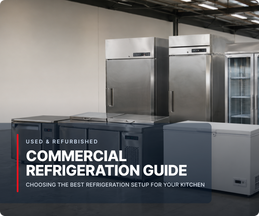
Commercial Refrigeration Buying Guide: Used & Refurbished
Choosing the right commercial fridge, freezer or display unit for your business
Commercial refrigeration is one of the hardest-working parts of any professional kitchen. It protects stock, supports food safety, reduces waste and keeps ingredients accessible during service.
Choosing the right unit, however, involves more than finding a fridge or freezer that fits the available space.
You need to consider what will be stored, how frequently the doors will be opened, the temperature of the surrounding room, the internal layout, available ventilation and how the equipment fits into your daily workflow.
When buying used or refurbished commercial refrigeration, there are additional questions to ask. Has the unit been properly inspected? Does it reach and maintain temperature? Are the door seals, fans and compressor in suitable condition? Is the model still practical to service?
This guide explains the main types of commercial refrigeration, where each type works best and what to check before buying used or refurbished equipment.
Which type of commercial refrigeration do you need?
The right refrigeration depends primarily on how the unit will be used.
An upright cabinet may provide the greatest amount of organised storage within a relatively small footprint. An undercounter fridge keeps ingredients close to the working area. A refrigerated counter combines storage with additional preparation space, while a display fridge is designed to present products to customers.
As a starting point:
| What you need | Most suitable equipment |
|---|---|
| Maximum chilled storage in limited floor space | Upright commercial fridge |
| Ingredients close to the cooking line | Undercounter or bench fridge |
| Chilled storage with a preparation surface | Refrigerated counter |
| Ingredients arranged for food preparation | Prep counter or saladette |
| Cakes, drinks or packaged food displayed to customers | Display fridge |
| Fast access to bottled and canned drinks | Bottle cooler |
| Bulk frozen storage | Chest freezer |
| Organised frozen storage with easy access | Upright freezer |
| Frozen storage beneath a counter | Undercounter freezer |
| Rapid cooling of cooked food | Blast chiller |
| Rapid freezing of food | Blast freezer |
| Ice production for drinks or food display | Commercial ice maker |
This table provides a useful starting point, but capacity, temperature range, ventilation and surrounding conditions must also be considered.
Commercial refrigeration versus domestic refrigeration
Domestic and commercial refrigerators may appear similar, but they are designed for different working environments.
A domestic fridge normally sits in a relatively cool room and may only be opened occasionally throughout the day. Commercial refrigeration can be opened repeatedly during a busy service, positioned in a warmer kitchen and expected to recover temperature quickly.
Commercial equipment is generally designed around:
-
More frequent door opening
-
Heavier daily use
-
Faster temperature recovery
-
Stronger shelves, hinges and handles
-
Larger storage formats
-
Easier access to serviceable components
-
Commercial food containers and trays
-
More demanding kitchen environments
This does not mean that every commercial fridge is suitable for every professional kitchen. Some cabinets are intended for cooler front-of-house environments, while others are built to operate in hotter back-of-house conditions.
The location and ambient temperature still need to be checked before choosing a unit.
Types of commercial fridges
Upright commercial fridges
An upright commercial fridge provides a large amount of chilled storage while using relatively little floor space.
These cabinets are commonly used in restaurants, cafés, pubs, hotels, bakeries, takeaways and production kitchens. They are suitable for storing ingredients, prepared products, packaged food and general chilled stock.
Upright fridges may have one, two or three doors, depending on their size and intended use.
Advantages include:
-
High storage capacity
-
Organised shelving
-
Easy visibility of stock
-
Efficient use of vertical space
-
A wide choice of sizes and door configurations
Possible limitations include:
-
Doors requiring clearance to open
-
Difficulty passing through narrow delivery access
-
Greater loss of cold air when a full-height door is opened
-
A need for sufficient airflow around the refrigeration system
When buying a used upright commercial fridge, check the door seals, hinges, internal shelving, fans, drainage and temperature performance. Confirm that the unit fits through every doorway and corridor between the delivery vehicle and its final position.
The Herits view:
An upright fridge is usually the best choice when storage capacity is more important than additional worktop space. It is particularly useful for kitchens that need clearly organised stock and frequent access throughout the day.
Undercounter commercial fridges
An undercounter commercial fridge fits beneath an existing work surface or counter.
It is commonly used in smaller cafés, bars, takeaway kitchens and preparation areas where space is limited. It can also be positioned close to the cooking line to keep frequently used ingredients within easy reach.
Advantages include:
-
Compact dimensions
-
Convenient ingredient access
-
Efficient use of otherwise unused space
-
Suitability for smaller commercial kitchens
-
Easier delivery and positioning than some upright cabinets
Possible limitations include:
-
Lower storage capacity
-
A need to bend down to reach products
-
Restricted airflow if installed too tightly
-
Less practical storage for large trays or bulky items
Do not assume that every undercounter fridge will fit beneath a standard counter. Commercial units can vary considerably in height and depth, particularly when castors, ventilation gaps and door handles are included.
The Herits view:
Undercounter refrigeration works best when accessibility matters more than maximum capacity. It is useful for ingredients needed during service, but it may not provide enough space to serve as the kitchen’s only refrigerator.
Commercial bench fridges and refrigerated counters
A commercial bench fridge combines chilled storage with a stainless-steel work surface.
These units are widely used in restaurant kitchens because they allow chefs to prepare food directly above refrigerated ingredients. They are available with doors, drawers or a combination of both.
Advantages include:
-
Chilled storage beneath the working area
-
Additional stainless-steel preparation space
-
Fast access during service
-
Several door and drawer configurations
-
Efficient use of kitchen floor space
Possible limitations include:
-
A larger footprint than an undercounter cabinet
-
Reduced internal capacity compared with an upright fridge
-
Ventilation requirements around the refrigeration system
-
More components to inspect on drawer models
Drawer units can be particularly useful where ingredients are stored in commercial food containers, but the drawer sizes and internal format should be checked before purchase.
The Herits view:
A refrigerated counter is often one of the most practical choices for a busy cooking line. It improves workflow by placing ingredients directly beneath the preparation surface.
Prep counters and saladettes
A refrigerated prep counter is designed to support food preparation while keeping ingredients chilled and accessible.
These units are commonly used for pizzas, sandwiches, salads, wraps and cold food preparation. Many include an upper section for containers of ingredients, with additional refrigerated storage below.
Advantages include:
-
Ingredients arranged within easy reach
-
Faster preparation during busy periods
-
Chilled storage beneath the work area
-
Different layouts for pizza, salad and sandwich preparation
-
Improved organisation
Possible limitations include:
-
Open ingredient wells requiring careful management
-
Reduced work surface on some models
-
More seals, lids and containers to inspect
-
Specialist sizes that may not suit every tray format
Before buying, check whether the ingredient containers and internal storage use the sizes required by your operation. Do not assume that trays or containers are included unless they are clearly listed.
The Herits view:
A prep counter can significantly improve speed and organisation where the same range of chilled ingredients is used repeatedly. It is less useful for kitchens that need flexible, general-purpose refrigerated storage.
Commercial display fridges
Commercial display refrigeration keeps food or drinks chilled while presenting them to customers.
This category includes glass-door merchandisers, multidecks, grab-and-go cabinets, cake displays, countertop displays and patisserie refrigeration.
Display units are commonly used in cafés, convenience stores, bakeries, delis, canteens and takeaway businesses.
Advantages include:
-
Clear product visibility
-
Customer-facing presentation
-
Faster purchasing decisions
-
Easy access to packaged products
-
Internal lighting on many models
Possible limitations include:
-
Glass doors transferring more heat than solid doors
-
Higher exposure to warm air
-
Greater importance of lighting and presentation
-
Less suitability for hidden bulk storage
-
Different ambient-temperature limitations between models
A display fridge should be chosen according to the product being presented. A bottle cooler, cake display, multideck and upright display cabinet are not interchangeable simply because they all contain glass.
The Herits view:
Display refrigeration should be treated as both equipment and part of the customer experience. Temperature performance is essential, but appearance, lighting, shelf layout and ease of access also matter.
Bottle coolers
Bottle coolers are designed for storing and displaying bottled or canned drinks.
They are commonly installed behind bars, beneath counters and in customer-facing drinks areas. Models may have solid, hinged glass or sliding glass doors.
Advantages include:
-
Fast access during drinks service
-
Internal layouts designed for bottles and cans
-
Product visibility
-
Compact undercounter formats
-
Multiple door configurations
Possible limitations include:
-
Limited suitability for general food storage
-
Sliding tracks and door runners requiring inspection
-
Condensers becoming blocked in dusty bar environments
-
Glass doors allowing more heat transfer
When buying used, inspect the door tracks, lighting, shelving, fans and seals. Check for damage caused by repeated loading of bottles.
The Herits view:
A proper bottle cooler is generally more practical for bar service than a general-purpose kitchen fridge. The layout and door design are better suited to rapid access and product presentation.
Specialist commercial fridges
Some businesses require refrigeration designed around specific products or tray formats.
Examples include:
-
Bakery fridges
-
Meat-storage cabinets
-
Fish refrigeration
-
Patisserie cabinets
-
Retarder provers
-
Medical or specialist temperature-controlled cabinets
These units should not be purchased solely because their external dimensions appear suitable. The internal layout, humidity control, temperature range and intended product type must be confirmed.
The Herits view:
Specialist refrigeration can be extremely valuable when it matches the operation. When it does not, it may be less flexible than an ordinary commercial cabinet.
Types of commercial freezers
Upright commercial freezers
An upright commercial freezer provides organised frozen storage with easier access than a chest freezer.
Shelves allow stock to be separated clearly, reducing the need to search through stacked products. Upright freezers are widely used in restaurants, cafés, bakeries, pubs and production kitchens.
Advantages include:
-
Organised frozen storage
-
Efficient use of vertical space
-
Easy access to stock
-
A smaller footprint than many chest freezers
-
Single, double and multiple-door options
Possible limitations include:
-
More cold air escaping when doors are opened
-
Less efficient storage of unusually bulky items
-
Door clearance requirements
-
Potential ice build-up if seals or defrost systems are faulty
The Herits view:
An upright freezer is usually the better option when staff need quick, organised access to a varied range of frozen products.
Undercounter commercial freezers
An undercounter freezer provides compact frozen storage beneath a counter or work surface.
It is useful for small kitchens, bars and preparation areas that only require limited frozen capacity or need specific items close to the working position.
Advantages include:
-
Compact size
-
Convenient positioning
-
Useful secondary freezer storage
-
Easier access to frequently used products
Possible limitations include:
-
Limited capacity
-
Less efficient for bulk frozen stock
-
A need for adequate ventilation
-
More bending during use
The Herits view:
An undercounter freezer is best used as accessible working storage rather than the main frozen storage solution for a high-volume kitchen.
Commercial chest freezers
Chest freezers provide a large amount of frozen storage and are particularly suitable for bulky stock.
They are commonly used for boxed products, frozen ingredients, ice cream and backup storage.
Advantages include:
-
High storage capacity
-
Effective use of internal volume
-
Suitability for bulky products
-
Reduced cold-air loss when the lid is opened
-
Straightforward internal construction
Possible limitations include:
-
Stock becoming difficult to organise
-
Items at the bottom being harder to reach
-
A larger floor-space requirement
-
A need for clearance above the lid
-
Less convenient access during service
Check whether baskets or dividers are included. Missing internal baskets can make an otherwise useful freezer difficult to organise.
The Herits view:
A chest freezer is usually the best value where bulk capacity is the priority. It is less suitable when staff need rapid access to many different products throughout service.
Commercial bench freezers
A bench freezer combines frozen storage with a work surface.
These are useful where frozen products must remain close to the preparation or cooking area. Models may contain doors, drawers or both.
The main advantages are similar to a refrigerated counter, but frozen-storage requirements place greater demands on seals, insulation and temperature recovery.
The Herits view:
A bench freezer can improve workflow, but it should be chosen carefully. Drawer dimensions, internal capacity and ventilation are particularly important.
Display freezers
Display freezers allow customers to see frozen products while maintaining the required temperature.
Examples include glass-door upright freezers, ice-cream displays and retail frozen-food cabinets.
Advantages include:
-
Product visibility
-
Customer self-selection
-
Improved merchandising
-
Internal lighting
-
Different shelf and basket layouts
Possible limitations include:
-
Greater heat transfer through glass
-
More complex lighting and door components
-
Presentation becoming part of the buying decision
-
Limited suitability for hidden bulk storage
The Herits view:
A display freezer needs to perform commercially and present products well. Scratched glass, damaged lighting and missing shelves can reduce its value even when it freezes correctly.
Commercial fridge-freezers
A commercial fridge-freezer combines chilled and frozen storage within one appliance.
This can be useful where space is limited and both temperature zones are required. However, the internal capacity of each section may be smaller than expected.
Before buying, confirm:
-
Which section is chilled
-
Which section is frozen
-
The capacity of each compartment
-
Whether the zones operate independently
-
The door configuration
-
The available shelf space
The Herits view:
A fridge-freezer can solve a genuine space problem, but separate appliances usually offer greater capacity and flexibility.
Blast freezers
A blast freezer is designed to reduce food temperature rapidly and freeze products more quickly than ordinary storage equipment.
It is used in production kitchens, bakeries, food manufacturing and operations where preserving quality and controlling cooling times are important.
A blast freezer is not simply a more powerful storage freezer. It is a specialist piece of equipment with different controls, tray formats and operating requirements.
The Herits view:
Blast equipment should be specified according to batch size, tray format, power supply and production process. Buying only by external size can result in an unsuitable unit.
Blast chillers
A blast chiller rapidly reduces the temperature of cooked or prepared food before it is moved into normal chilled storage.
This can support safer food handling, improve production planning and help preserve food quality.
Before choosing a blast chiller, consider:
-
The amount of food processed per batch
-
Tray or Gastronorm format
-
Chilling cycle capacity
-
Electrical supply
-
Drainage requirements
-
Probe condition
-
Control-panel condition
-
Available ventilation
The Herits view:
A blast chiller is valuable for businesses producing food in batches, but its capacity should be based on the amount of food being chilled rather than the cabinet’s physical size alone.
Commercial ice makers
Commercial ice makers are used in bars, restaurants, hotels, cafés, fish counters and food-display operations.
Different machines produce different ice formats, including cubes, flakes, nuggets and granular ice.
Before buying, check:
-
Ice type
-
Production capacity
-
Storage-bin capacity
-
Water supply
-
Drainage
-
Electrical requirements
-
Water filtration
-
Condenser type
-
Cleaning condition
Air-cooled machines require suitable airflow, while water quality can affect performance and scale build-up.
The Herits view:
Choose an ice maker according to peak demand, not average demand. A unit that produces enough ice over 24 hours may still struggle during a short, busy service period if the storage bin is too small.
How to choose the correct commercial refrigeration
Start with what you are storing
The product determines the equipment.
Consider whether you need to store:
-
Packaged ingredients
-
Raw meat
-
Fish
-
Dairy products
-
Prepared meals
-
Frozen stock
-
Cakes and desserts
-
Bottles and cans
-
Sandwiches and grab-and-go food
-
Bakery trays
-
Gastronorm containers
Different products may require different shelf layouts, temperatures, humidity levels and access arrangements.
Consider how staff will use it
Think about the working pattern, not just the storage capacity.
Ask:
-
How often will the doors be opened?
-
How many staff need access?
-
Does the equipment need to sit beside the cooking line?
-
Will products be stored in boxes, trays or containers?
-
Does stock need to be visible to customers?
-
Will the top be used as a preparation surface?
-
Is the unit for main storage or service storage?
A fridge that looks large on paper may be inefficient if staff cannot reach the required ingredients quickly.
Check usable capacity
Manufacturers may state internal capacity in litres, but this does not always reflect the amount of stock that can be stored practically.
Fans, shelves, evaporators, drawer mechanisms and door layouts all affect usable space.
Measure the products and containers you intend to use. In particular, confirm whether the equipment accepts the required bakery trays or Gastronorm sizes.
Measure the space carefully
Measure:
-
Maximum available width
-
Maximum available depth
-
Maximum available height
-
Clearance for doors and drawers
-
Ventilation space
-
Space around handles
-
Access for cleaning and servicing
-
Doorways and corridors
-
Steps and tight corners
-
Vehicle access at the delivery address
Do not measure only the final position. The equipment must pass through the entire delivery route.
Check the surrounding temperature
Commercial kitchens can become significantly hotter than cafés, shops and customer-facing areas.
A cabinet designed for a cooler environment may struggle if positioned beside an oven, fryer or cooking range.
Check the manufacturer’s stated operating conditions where available. Allow sufficient airflow and avoid surrounding the refrigeration system with stored boxes or fixed panels.
Consider solid or glass doors
Solid doors usually provide better insulation and conceal stock. Glass doors allow staff or customers to see the contents without opening the cabinet.
Solid doors are generally suited to:
-
Back-of-house storage
-
Busy kitchens
-
Stock that does not need to be displayed
-
Environments where efficiency is a priority
Glass doors are generally suited to:
-
Drinks displays
-
Retail products
-
Front-of-house use
-
Cabinets where visibility improves stock control
The correct choice depends on whether visibility or maximum thermal efficiency is more important.
Check doors versus drawers
Doors provide flexible storage and are usually easier to reconfigure using shelves.
Drawers can improve organisation and provide faster access to ingredients stored in containers. However, drawer depth, runners and seals must be checked carefully.
Check the power requirements
Do not assume that commercial refrigeration will always operate from an ordinary plug.
Check the data plate for:
-
Voltage
-
Phase
-
Frequency
-
Power rating
-
Current
-
Plug or hardwiring requirements
Specialist units such as blast chillers, blast freezers and larger ice makers may have more demanding electrical requirements.
Consider servicing and parts
A low purchase price can become expensive if essential components are obsolete or difficult to source.
Before buying older equipment, consider:
-
Brand support
-
Parts availability
-
Availability of technical information
-
Compressor and controller compatibility
-
Door-seal availability
-
Whether local engineers are familiar with the model
This does not mean that older equipment should automatically be avoided. Many established commercial cabinets remain practical to maintain. The exact model and condition matter more than age alone.
What should you check when buying used commercial refrigeration?
Used commercial refrigeration can offer substantial value, but a low price should not replace proper inspection.
A unit can look clean while still containing expensive mechanical or electrical faults.
Confirm the make and model
The manufacturer’s data plate is one of the most important parts of the equipment.
It may show:
-
Manufacturer
-
Model number
-
Serial number
-
Voltage
-
Power rating
-
Refrigerant
-
Refrigerant charge
-
Manufacturing information
The exact model helps confirm specifications, parts availability and whether the equipment suits its intended purpose.
Do not rely solely on the badge attached to the front. Components and doors can be replaced, and some cabinets look very similar across different model ranges.
Check that it reaches temperature
A refrigeration unit switching on does not prove that it works correctly.
A proper assessment should consider whether the unit:
-
Starts normally
-
Pulls down towards its operating temperature
-
Holds temperature over time
-
Recovers after the door is opened
-
Operates without unusual cycling
-
Produces an accurate temperature reading
The controller display should not be treated as the only evidence. Temperature should be checked independently where possible.
Listen to the compressor and fans
Unusual noises may indicate wear, loose components or developing faults.
Listen for:
-
Repeated clicking
-
Excessive rattling
-
Grinding fans
-
Very short operating cycles
-
A compressor running continuously without pulling down
-
Changes in sound as the unit reaches temperature
Some operating noise is normal. The purpose is to identify anything inconsistent, excessive or clearly abnormal.
Inspect the condenser
The condenser needs sufficient airflow to remove heat from the refrigeration system.
Grease, dust and debris can restrict airflow, causing the unit to run harder and potentially increasing the risk of breakdown.
Check whether the condenser is accessible and whether it has been cleaned. Also check that vents are not damaged or blocked.
Check the door seals
Damaged seals allow warm air to enter the cabinet.
Look for:
-
Splits
-
Missing sections
-
Hardened rubber
-
Loose corners
-
Poor contact with the cabinet
-
Doors that do not close correctly
Replacement seals may be available, but their cost and availability should be considered before purchase.
Inspect hinges, catches and handles
Commercial refrigeration doors are opened repeatedly throughout the day.
Check that:
-
Doors sit squarely
-
Hinges are secure
-
Handles are fixed properly
-
Catches engage
-
Doors do not drop
-
Self-closing mechanisms operate where fitted
-
Sliding doors move smoothly
A dropped door can prevent the seal from making proper contact even when the rubber itself appears intact.
Inspect the interior
Look carefully at:
-
Shelves
-
Shelf supports
-
Drawer runners
-
Fan guards
-
Interior lights
-
Drain holes
-
Drain pans
-
Door liners
-
Cabinet joints
-
Internal corrosion
-
Cracked plastic
-
Missing fittings
-
Signs of standing water
-
Evidence of previous leaks
Confirm which shelves, trays, baskets and containers are included in the sale.
Check the controls
Digital controllers should respond correctly and display clearly.
Check for:
-
Missing buttons
-
Damaged screens
-
Fault codes
-
Loose control panels
-
Incorrect readings
-
Unresponsive settings
-
Temporary repairs
On specialist equipment, confirm that probes and programmed cycles function as intended.
Identify the refrigerant
The refrigerant should be shown on the data plate.
This matters because it can affect future servicing, component compatibility and the practicality of maintaining an older unit.
Do not assume that a newer refrigerant automatically makes a cabinet better, or that an older refrigerant automatically makes it unusable. The condition, model, service history and availability of suitable support all need to be considered together.
Check for signs of previous repairs
Previous repair work is not necessarily a problem. Commercial equipment is designed to be serviced.
However, repairs should be secure and appropriate.
Look for:
-
Loose wiring
-
Damaged insulation
-
Unsecured controllers
-
Poorly fitted replacement parts
-
Temporary tape repairs
-
Missing panels
-
Non-standard switches
-
Excess sealant
-
Signs of repeated refrigerant work
Where possible, ask what repairs have been completed and whether replacement components were used.
Check the external condition
Cosmetic wear is normal on used commercial equipment.
Scratches, marks and small dents may not affect performance. More significant damage can affect doors, insulation, drainage or structural alignment.
Assess whether the condition is consistent with the price and intended location. A back-of-house cabinet may not need to look perfect, while customer-facing display refrigeration requires a higher cosmetic standard.
Ask what has been tested
The words used to describe second-hand equipment are not always consistent.
There is an important difference between:
Untested
The equipment has not been properly assessed.
Used
The equipment has previously been in service. This does not automatically mean it has been cleaned, serviced or tested.
Cleaned
The equipment has been cosmetically or hygienically cleaned. Cleaning alone does not prove mechanical performance.
Tested
The equipment has undergone a stated operational test. The buyer should ask what was tested and for how long.
Serviced
Specific maintenance or repair work has been carried out.
Refurbished
The equipment has undergone a broader process of inspection, cleaning, testing and repair. The seller should be able to explain what this process included.
Warranted
The seller provides a stated warranty subject to its written terms.
The description should match the work genuinely completed. “Refurbished” should not be used merely because an item has been wiped down and switched on.
Used or refurbished commercial refrigeration?
Used and refurbished equipment can both provide good value, but they represent different levels of preparation.
Used equipment may be suitable where the buyer understands the condition and is prepared to accept a greater level of risk.
Refurbished equipment should offer more reassurance because it has undergone a clearer inspection and preparation process. The exact standard still depends on the seller, so buyers should ask what has been done.
When comparing equipment, consider:
-
Purchase price
-
Testing completed
-
Repairs completed
-
Cosmetic condition
-
Warranty
-
Parts availability
-
Delivery
-
Installation requirements
-
Future servicing
-
Expected workload
The cheapest unit is not always the lowest-cost option once repairs, transport and lost trading time are included.
The Herits approach to commercial refrigeration
At Herits Food Machinery, we deal with a wide range of used and refurbished commercial refrigeration, including:
-
Upright fridges
-
Undercounter fridges
-
Refrigerated counters
-
Prep counters
-
Display fridges
-
Bottle coolers
-
Upright freezers
-
Undercounter freezers
-
Chest freezers
-
Display freezers
-
Blast chillers
-
Blast freezers
-
Commercial ice makers
-
Specialist refrigeration
Each item is assessed individually.
The exact work required depends on the model, its condition and how it arrived with us. This may include identification, cleaning, inspection, operational testing, temperature testing and repairs where required.
We do not believe that every business needs the newest or most expensive refrigeration available.
The right equipment is the unit that suits the product, workload, available space, utilities and budget while providing a practical level of reliability and support.
Common commercial refrigeration buying mistakes
Buying on external dimensions alone
A cabinet may fit the available space but still offer the wrong internal layout, insufficient capacity or unsuitable ventilation.
Ignoring the delivery route
Large upright cabinets may not pass through narrow doors, corridors or stairways.
Blocking the ventilation
Restricted airflow can reduce performance and place additional strain on the refrigeration system.
Positioning refrigeration beside high-heat equipment
Heat from ovens, fryers and cooking ranges can make refrigeration work harder.
Assuming the display temperature is accurate
A digital number does not replace proper temperature assessment.
Choosing display refrigeration for bulk storage
Display cabinets are designed around product visibility. They may not be the most efficient or practical choice for hidden back-of-house stock.
Buying too little capacity
An overfilled cabinet can restrict airflow and make stock difficult to manage.
Buying too much capacity
An unnecessarily large unit uses more space and may create avoidable running and maintenance costs.
Ignoring shelves and internal fittings
Replacement shelves, runners, baskets and containers can be costly or difficult to source.
Confusing cleaned with refurbished
A clean cabinet may still have mechanical, electrical or temperature-control problems.
Commercial refrigeration by business type
Restaurants
Restaurants often benefit from a combination of upright storage and refrigerated counters.
A typical arrangement may include:
-
Upright fridge for bulk chilled stock
-
Upright freezer for organised frozen storage
-
Bench fridge beside the cooking line
-
Prep counter for frequently used ingredients
-
Blast chiller for batch production
Cafés
Cafés frequently require a mixture of storage and display refrigeration.
Useful equipment may include:
-
Undercounter fridge
-
Cake display fridge
-
Upright storage fridge
-
Bottle cooler
-
Display fridge
-
Compact freezer
-
Ice maker
Pubs and bars
Drinks service and kitchen storage may need to be considered separately.
Useful equipment may include:
-
Bottle coolers
-
Ice maker
-
Upright or undercounter kitchen fridge
-
Chest or upright freezer
-
Refrigerated counter
Bakeries
Bakeries may require specialist internal formats and customer-facing presentation.
Useful equipment may include:
-
Bakery-format upright fridge
-
Upright or chest freezer
-
Patisserie display
-
Blast chiller or freezer
-
Retarder prover
-
Refrigerated preparation counter
Takeaways
Takeaway kitchens often need high capacity within a restricted footprint.
Useful equipment may include:
-
Upright fridge
-
Upright freezer
-
Prep counter
-
Undercounter service fridge
-
Chest freezer
-
Bottle cooler
Shops and delis
Display and customer access are often the main priorities.
Useful equipment may include:
-
Multideck
-
Glass-door display fridge
-
Serve-over counter
-
Upright storage fridge
-
Display freezer
-
Ice-cream freezer
Frequently asked questions
What is the difference between a commercial fridge and a domestic fridge?
A commercial fridge is designed for more frequent use, repeated door opening and the demands of a professional kitchen. It will often have stronger components, faster temperature recovery and a layout intended for commercial stock or containers.
Is it safe to buy a used commercial fridge?
Used commercial refrigeration can be a practical purchase when the unit has been correctly identified and its condition and temperature performance have been properly assessed. Buyers should check the seals, fans, compressor, condenser, controls, interior and serviceability.
What does refurbished commercial refrigeration mean?
Refurbished should mean more than cleaning. It normally involves inspection, testing and any necessary repair or replacement work. Because sellers may use the term differently, ask exactly what has been completed.
Should I buy an upright or undercounter fridge?
Choose an upright fridge when maximum storage capacity is the priority. Choose an undercounter fridge when ingredients need to remain close to the working area or space is limited.
Are glass-door fridges less efficient?
Glass allows more heat transfer than an insulated solid door. However, glass doors allow staff or customers to see products without opening the cabinet. The correct choice depends on whether visibility or maximum insulation is more important.
How much space should I leave around a commercial fridge?
The required clearance varies by model and condenser position. Always check the manufacturer’s guidance where available and avoid blocking ventilation grilles or service access.
Can a commercial fridge sit beside an oven?
It may operate beside cooking equipment, but high surrounding temperatures can reduce efficiency and increase strain. Where possible, provide separation, airflow and protection from direct heat.
What should I photograph when asking about a used fridge?
Photograph the full unit, front, sides, interior, controls, plug or electrical connection and the complete manufacturer’s data plate. Clear photographs of damage, missing parts and handwritten measurements are also useful.
Does the refrigerant matter?
Yes. Refrigerant can affect servicing, component compatibility and the practical future maintenance of the unit. Confirm it from the manufacturer’s data plate rather than guessing from the age or appearance.
How do I know whether a used fridge is holding temperature?
The unit should be allowed to pull down and operate over a reasonable test period. Temperature should be checked independently rather than relying solely on the cabinet display.
Is a chest freezer better than an upright freezer?
A chest freezer usually offers strong bulk-storage capacity. An upright freezer provides easier organisation and faster access. The better choice depends on how often staff need to reach different products.
What is the difference between a blast chiller and a normal fridge?
A blast chiller is designed to reduce the temperature of food rapidly. A normal commercial fridge is designed primarily to store products that are already chilled.
Do commercial ice makers need drainage?
Many commercial ice makers require a water supply and a suitable drain. The exact requirements depend on the model and must be confirmed before installation.
Should I buy new, used or refurbished refrigeration?
New equipment may provide the latest specification and a manufacturer-backed warranty. Used equipment can offer the lowest purchase price but may carry more risk. Refurbished equipment can provide a balance between price and reassurance when the work completed is clearly explained.
Choosing commercial refrigeration: the Herits view
The best commercial fridge or freezer is not necessarily the largest, newest or most expensive.
It is the unit that matches:
-
What you need to store
-
How staff will use it
-
The available space
-
The surrounding temperature
-
The required internal format
-
The available power and utilities
-
Your expected workload
-
Your budget
-
Your servicing requirements
When buying used or refurbished equipment, condition and testing matter just as much as brand and model.
A properly selected unit should fit into the kitchen’s workflow, provide suitable capacity and remain practical to maintain.
Looking for used or refurbished commercial refrigeration?
Herits Food Machinery stocks a wide range of commercial fridges, freezers, refrigerated counters, display units, bottle coolers, blast chillers and ice makers.
Send us the available dimensions, what you need to store, your preferred capacity and your delivery postcode. We can review the current stock and help narrow down the most suitable options.
Browse our current commercial refrigeration range or contact Herits for practical advice.