
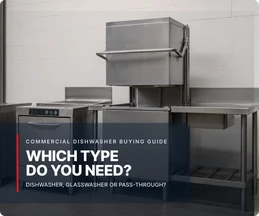
Posted by Herits Food Machinery on 26th Aug 2026
Title Commercial Dishwasher Buying Guide: Which Type Do You Need?
Choosing the right commercial dishwasher is not simply a matter of finding a machine that fits beneath a counter.
The correct warewashing setup depends on what you are washing, how much you need to process during peak service, available space, electrical supply, water pressure, drainage and the way dirty and clean items move through the kitchen.
A small café may be perfectly served by an undercounter dishwasher. A busy restaurant may need a pass-through machine capable of processing basket after basket throughout service. A bar may require a dedicated glasswasher, while bakeries and production kitchens can need something considerably heavier.
The decision becomes even more important when buying used or refurbished commercial dishwashing equipment. A second-hand machine can represent excellent value, but only when its condition, specification and operation have been properly assessed.
This guide explains the main types of commercial dishwasher, what each is designed for, the specifications that matter and what to check before buying used or refurbished warewashing equipment.
Which type of commercial dishwasher do you need?
As a starting point:
| Requirement | Most likely equipment |
|---|---|
| Small café or light food service | Undercounter dishwasher |
| Pub or bar | Commercial glasswasher |
| Busy restaurant | Pass-through dishwasher |
| Hotel or high-volume kitchen | Pass-through or larger warewashing system |
| Bakery or production kitchen | Potwasher or utensil washer |
| Heavy pots, trays and containers | Potwasher |
| Glasses only | Glasswasher |
| Limited space | Undercounter machine |
This is only a starting point.
Two restaurants serving the same number of customers may still need different machines depending on menu, service pattern, basket size and how quickly crockery needs to return to use.
The best commercial dishwasher is therefore the machine that can comfortably cope with peak demand, not simply the average number of covers served during the day.
Commercial dishwasher vs domestic dishwasher
A commercial dishwasher and a domestic dishwasher perform the same basic task, but they are designed around very different working environments.
Domestic machines typically use longer cycles and are designed for relatively limited use throughout the day.
Commercial dishwashers are built around speed and repeated operation.
Depending on the machine, a commercial wash cycle may take only a few minutes, allowing the same baskets, plates, utensils or glasses to return to service quickly.
Commercial machines are generally designed for:
-
Repeated cycles throughout service
-
Faster wash times
-
Higher operating temperatures
-
Standard commercial baskets
-
Heavier daily workloads
-
Commercial detergent and rinse-aid systems
-
Easier servicing
-
Integration into professional kitchen workflows
This is why capacity should not be judged simply by the internal size of the machine.
Cycle time and basket throughput matter just as much.
Undercounter commercial dishwashers
An undercounter commercial dishwasher is one of the most common choices for cafés, pubs, smaller restaurants, takeaways and other businesses with moderate warewashing requirements.
The machine normally sits beneath a worktop and is loaded from the front.
Typical advantages include:
-
Compact footprint
-
Straightforward installation
-
Fast access
-
Suitable for smaller kitchens
-
Lower purchase cost than larger pass-through systems
-
Standard commercial basket formats on many models
Possible limitations include:
-
Lower throughput than a pass-through dishwasher
-
Staff repeatedly bending to load and unload
-
Limited space for larger pots and trays
-
Dirty and clean items potentially crossing in a poorly planned layout
Who should consider an undercounter dishwasher?
An undercounter machine can work well for:
-
Cafés
-
Coffee shops
-
Smaller pubs
-
Takeaways
-
Small restaurants
-
Staff kitchens
-
Low-to-medium-volume catering operations
The important question is whether it can recover quickly enough during your busiest period.
A machine that performs perfectly during a quiet Tuesday afternoon may become a bottleneck during Saturday service.
What to check when buying used
When buying a used or refurbished undercounter dishwasher, check:
-
Wash pump operation
-
Rinse temperature
-
Wash temperature
-
Door condition
-
Heating elements
-
Drainage
-
Spray arms
-
Chemical dosing
-
Basket condition
-
Scale build-up
-
Electrical requirements
-
Whether the machine completes a full cycle correctly
Do not judge a used dishwasher simply because the control panel lights up.
It needs to perform the job it was designed to do.
Commercial glasswashers
A commercial glasswasher is designed specifically around glasses and drinks service.
They are widely used in:
-
Pubs
-
Bars
-
Hotels
-
Clubs
-
Restaurants
-
Cafés
-
Event venues
Glasswashers generally provide quick cycles and basket layouts designed for glassware.
Dishwasher or glasswasher?
Although the two machines can appear similar externally, they should not automatically be treated as interchangeable.
Glassware presents different requirements from heavily soiled plates, trays and cooking utensils.
A dedicated glasswasher can provide:
-
Faster glass turnaround
-
Basket layouts suited to glassware
-
Reduced handling
-
Better drinks-service workflow
-
Separation between bar and kitchen washing
A busy bar can quickly develop problems if glasses are constantly being carried into the main kitchen dishwasher.
Likewise, a small glasswasher should not automatically be expected to replace a full commercial dishwasher handling heavily soiled crockery.
What to check on a used glasswasher
For a used or refurbished commercial glasswasher, inspect:
-
Basket size
-
Spray arms
-
Wash pump
-
Rinse system
-
Door seals
-
Drainage
-
Heating
-
Chemical dosing
-
Internal scale
-
Glass racks
-
Controls
Also confirm whether a water softener is required.
Clean glassware is particularly unforgiving. Poor rinse performance or water-quality problems can leave visible spotting and marks.
Pass-through dishwashers
For busy restaurants, hotels and commercial kitchens, a pass-through dishwasher can dramatically improve workflow.
Rather than bending down and loading through a front door, the operator lifts a hood, slides a loaded basket into the machine and lowers the hood to begin the cycle.
Once finished, the basket can continue onto the clean side.
This creates a logical process:
Dirty items → pre-rinse → dishwasher → clean side
That workflow is one of the biggest advantages of a pass-through system.
Advantages of pass-through dishwashers
-
High basket throughput
-
Faster loading and unloading
-
Better kitchen workflow
-
Suitable for repeated heavy use
-
Can be integrated with dirty and clean tables
-
Less bending for staff
-
Suitable for higher-volume restaurants
Limitations
-
Requires more floor space
-
Requires suitable tabling
-
Often needs a more substantial electrical supply
-
Needs sufficient hood clearance
-
Installation requirements can be greater
-
Usually costs more than an undercounter machine
Do you need dishwasher tables?
Ideally, a proper pass-through setup includes a dirty-side inlet table and a clean-side outlet table.
The dirty side may also contain a sink or pre-rinse spray.
This means baskets can move logically through the wash area without clean and dirty crockery constantly crossing over each other.
When buying a refurbished pass-through dishwasher, consider the whole installation, not just the machine.
A bargain dishwasher becomes less attractive if you later discover you also require specially sized tables, a new electrical supply and changes to drainage.
Potwashers and utensil washers
A normal commercial dishwasher is designed primarily around crockery.
A potwasher is designed for much heavier items.
Typical applications include:
-
Bakery trays
-
Gastronom pans
-
Stock pots
-
Mixing bowls
-
Production containers
-
Large kitchen utensils
-
Food manufacturing equipment
Potwashers tend to offer larger wash chambers and are built to deal with heavier loads.
They can be particularly useful in:
-
Bakeries
-
Hotels
-
Food production
-
Large restaurants
-
Butchers
-
Central kitchens
When is a potwasher worth it?
If staff are spending significant amounts of time manually washing large trays, pans or containers because they simply do not fit in the dishwasher, a potwasher can improve productivity substantially.
But they are specialist machines.
Check:
-
Internal loading dimensions
-
Basket or rack size
-
Electrical supply
-
Water demand
-
Drainage
-
Cycle times
-
Door clearance
-
Overall dimensions
With used potwashers, parts availability also deserves close attention because some machines have seen very demanding production use.
Basket size matters
Basket size is one of the easiest commercial dishwasher specifications to overlook.
Common commercial machines may use sizes such as:
-
400 × 400 mm
-
450 × 450 mm
-
500 × 500 mm
Larger machines and specialist warewashing equipment may use different formats.
The important point is that basket size affects:
-
How many plates fit per cycle
-
Glass capacity
-
Tray compatibility
-
Overall throughput
-
Replacement basket availability
-
Compatibility with existing kitchen equipment
A machine with a very fast cycle is less useful if its basket is too small for what you need to wash.
If you already own commercial baskets, check whether they will fit the replacement machine before buying.
How many baskets per hour do you need?
Manufacturers often describe commercial dishwasher capacity in baskets per hour.
This is useful, but the figure needs context.
Imagine a machine with a two-minute theoretical cycle.
In perfect conditions, that could suggest around 30 cycles per hour.
In reality, staff still need time to:
-
Load baskets
-
Remove food debris
-
Pre-rinse
-
Open and close the machine
-
Unload clean items
-
Organise crockery
Real-world throughput may therefore be lower.
When sizing a machine, focus on your busiest service period.
Ask:
-
How many covers can arrive within an hour?
-
How many plates does each customer use?
-
Are bowls, cups or side plates also required?
-
How quickly does crockery need to return to service?
-
Will the dishwasher also handle kitchen utensils?
A slightly larger machine can provide useful capacity during busy periods, but buying dramatically more capacity than required can waste space and money.
Commercial dishwasher cycle times
Fast cycle times are one of the main advantages of commercial warewashing.
But the shortest cycle is not automatically the best setting for every load.
Heavier soiling may require:
-
Pre-rinsing
-
A longer cycle
-
Correct detergent
-
Correct wash temperature
-
Proper loading
A very fast machine cannot compensate for poor preparation.
Scrape food waste before loading and avoid stacking items so tightly that water cannot reach the surfaces.
Wash temperature and rinse temperature
Temperature is a fundamental part of commercial warewashing performance.
Commercial dishwashers typically use separate washing and rinsing stages, with the final rinse operating at a higher temperature than the main wash on many systems.
When assessing a machine, especially a used dishwasher, check that it:
-
Fills correctly
-
Heats correctly
-
Reaches its required wash temperature
-
Reaches its required rinse temperature
-
Completes the cycle without faults
-
Maintains performance over repeated operation
A machine that washes but cannot reach the required rinse conditions has not passed a meaningful functional test.
Drain pump vs gravity drain
This sounds technical, but it is an important installation question.
Gravity drain
A gravity-drain machine relies on water flowing naturally downwards into the waste connection.
The drainage point therefore needs to be positioned appropriately.
Drain pump
A drain pump actively pumps waste water from the machine.
This can give more flexibility where the building's waste connection is higher or where gravity drainage is unsuitable.
Before buying any commercial dishwasher, establish:
-
Where the waste connection is
-
Whether the machine has a drain pump
-
Whether it needs one
-
Whether existing drainage is suitable
Do this before the machine arrives.
Does a commercial dishwasher need a water softener?
In hard-water areas, water treatment can be extremely important.
Limescale can build up on:
-
Heating elements
-
Boilers
-
Wash arms
-
Rinse jets
-
Internal pipework
-
Temperature sensors
Over time this can reduce performance and contribute to breakdowns.
Some commercial dishwashers have an integral water softener.
Others require an external softener.
Why this matters when buying used
Heavy scale inside a second-hand commercial dishwasher can provide clues about its previous operating environment and maintenance.
When inspecting used or refurbished warewashing equipment, look for scale around:
-
Heating areas
-
Wash tanks
-
Spray arms
-
Rinse components
-
Internal surfaces
Descaling can be part of refurbishment, but severe long-term scale may also have affected components that are not immediately visible.
The Herits view:
Water treatment is cheaper than repeatedly repairing damage caused by scale.
If you operate in a hard-water area, treat the softener as part of the dishwasher installation rather than an optional extra.
Electrical requirements: check before buying
Commercial dishwashers can have very different electrical requirements.
Do not assume that every undercounter dishwasher connects to a standard 13A socket.
Depending on model and performance, equipment may require:
-
13A supply
-
16A supply
-
20A or 32A supply
-
Single-phase power
-
Three-phase power
-
Hardwiring
Higher-powered machines may recover heat more quickly between cycles, which can support heavier throughput.
But that performance is useless if the premises cannot supply the required power.
Before purchasing, check the manufacturer's data plate for:
-
Voltage
-
Phase
-
Frequency
-
Current
-
Power rating
If you are unsure, have the available supply checked by a qualified electrician.
Never buy a machine based on the assumption that the plug can simply be changed.
Water supply and pressure
Commercial dishwashers also depend on an appropriate water supply.
Check the manufacturer's requirements for:
-
Water pressure
-
Incoming temperature
-
Connection size
-
Water hardness
Insufficient water pressure can affect machine performance.
Some installations may require additional equipment to maintain suitable rinse pressure or water conditions.
When replacing an existing dishwasher, do not automatically assume that the new machine has identical requirements.
Detergent and rinse aid
Commercial warewashing equipment normally uses specialist detergent and rinse aid.
Many machines include automatic dosing systems.
Check whether the machine has:
-
Detergent dosing
-
Rinse-aid dosing
-
External chemical connections
-
Adjustable dosing controls
Incorrect chemical dosing can produce poor results even when the dishwasher itself is operating correctly.
Too little detergent may leave items dirty.
Too much can waste chemicals and contribute to poor results or residue.
What should you check when buying a used commercial dishwasher?
Used and refurbished warewashing equipment can provide strong value, but commercial dishwashers work in demanding environments.
A proper inspection matters.
Confirm the exact make and model
Start with the manufacturer's data plate.
Record:
-
Manufacturer
-
Model
-
Serial number
-
Voltage
-
Phase
-
Power rating
-
Manufacturing information where available
The exact model allows you to investigate parts availability and installation requirements.
Run a complete cycle
Do not accept:
"It turns on."
as evidence that a commercial dishwasher works.
A meaningful test should establish whether the machine:
-
Fills
-
Heats
-
Washes
-
Pumps correctly
-
Rinses
-
Drains
-
Completes its cycle
-
Reaches appropriate temperatures
-
Operates without fault codes
Ideally, repeat the cycle.
Some problems only become apparent once the machine has been operating for a period of time.
Inspect the wash pump
The wash pump drives the water circulation responsible for cleaning.
Listen for:
-
Excessive noise
-
Grinding
-
Intermittent operation
-
Weak circulation
-
Leaks
A tired pump can significantly reduce washing performance.
Check the spray arms
Make sure the spray arms:
-
Rotate freely
-
Are not cracked
-
Have clear jets
-
Fit securely
-
Are not heavily scaled
Blocked jets reduce coverage and can leave items improperly cleaned.
Check heating performance
Confirm that the machine heats both the wash water and rinse system as intended.
Faulty heating components can turn an apparently working dishwasher into a machine that is unsuitable for commercial operation.
Inspect the door or hood
Check:
-
Hinges
-
Handles
-
Door alignment
-
Hood movement
-
Safety switches
-
Seals
-
Springs where applicable
On a pass-through machine, the hood should operate smoothly and safely.
Look for scale
Heavy limescale can indicate:
-
Poor water treatment
-
Long periods without descaling
-
Operation in a hard-water area
Some visible scale can be removed during servicing. The bigger concern is what prolonged scale exposure may have done internally.
Check drainage
Make sure the machine drains correctly at the end of the cycle.
Inspect for:
-
Slow drainage
-
Pump noise
-
Blockages
-
Leaks
-
Damaged drain hoses
Inspect the wash tank
Look for:
-
Corrosion
-
Heavy scale
-
Debris
-
Damage
-
Weld repairs
-
Leaks
Stainless-steel construction is robust, but commercial machines can still suffer damage from years of hard use.
Check chemical dosing
Where automatic dosing is fitted, verify that the pumps and connections are present and in reasonable condition.
Check baskets and accessories
Confirm what is included.
A dishwasher without the correct baskets is not necessarily a problem, but replacement baskets add to the real purchase cost.
For pass-through installations, also check whether:
-
Inlet tables
-
Outlet tables
-
Pre-rinse sprays
-
Water softeners
-
Basket racks
are included or need to be sourced separately.
Used vs refurbished commercial dishwashers
There is an important distinction between used and refurbished warewashing equipment.
A used commercial dishwasher simply has a previous working history.
It may be sold exactly as removed from the previous site.
A properly refurbished commercial dishwasher should have undergone additional inspection and preparation before resale.
Depending on condition, that may include:
-
Cleaning
-
Descaling
-
Functional testing
-
Pump inspection
-
Heating checks
-
Drainage checks
-
Replacement of faulty components
-
Chemical-system checks
-
Final operational testing
There is no universal refurbishment standard across every seller.
Ask what has actually been done.
A clean stainless-steel exterior does not tell you the condition of the heating system, wash pump or boiler.
Is a used commercial dishwasher worth buying?
It can be.
Commercial dishwashers from established manufacturers are built to be serviced and repaired.
A professionally prepared refurbished dishwasher can therefore offer substantial savings compared with buying the equivalent new model.
But consider the whole proposition:
-
Purchase price
-
Condition
-
Age
-
Parts availability
-
Testing completed
-
Repairs completed
-
Water history
-
Electrical compatibility
-
Delivery
-
Installation
-
After-sales support
The cheapest used machine is not automatically the best-value machine.
A slightly more expensive refurbished unit that has been properly tested may reduce the risk of disruption once it reaches the kitchen.
Commercial dishwasher brands
There are numerous established warewashing manufacturers in the UK market.
Hobart
Hobart produces professional warewashing equipment across undercounter, glasswashing and pass-through formats.
Used Hobart machines are commonly encountered in commercial kitchens.
With any second-hand unit, assess the specific machine rather than buying on brand reputation alone.
Classeq
Classeq is widely used in UK hospitality and produces commercial dishwashers and glasswashers across different capacities.
Its machines are common in cafés, pubs, restaurants and commercial kitchens.
Maidaid
Maidaid manufactures a broad range of professional warewashing equipment, including undercounter and pass-through machines.
Again, exact model and specification are important.
Winterhalter
Winterhalter is well established in professional warewashing and produces machines for a wide range of applications.
Premium commercial machines can be attractive on the refurbished market because the saving compared with purchasing new can be substantial.
Other manufacturers
The used market also contains equipment from many other commercial brands.
Brand matters, but it should never replace inspection.
The right machine needs:
-
Suitable capacity
-
Available parts
-
Correct utilities
-
Good operational condition
-
Appropriate installation
-
A sensible purchase price
Commercial dishwasher buying mistakes
Buying the cheapest machine
A low price can disappear quickly if the machine needs a new pump, heating components, baskets, softener and electrical work.
Buying too small
A dishwasher operating continuously during peak service can become a major bottleneck.
Buying much too large
Excess capacity can waste money and kitchen space.
Ignoring basket size
Make sure the baskets suit your plates, trays and glasses.
Buying a glasswasher when you need a dishwasher
Choose the machine according to what it will actually wash.
Forgetting the water softener
Hard water and warewashing equipment are an expensive combination when water treatment is ignored.
Ignoring electrical requirements
Check power before paying for the machine.
Forgetting drainage
Confirm whether you need gravity drainage or a drain pump.
Forgetting hood clearance
Pass-through dishwashers require enough vertical space for the hood to open.
Forgetting dirty and clean tables
The pass-through machine is only part of the complete washing area.
Assuming power means operation
A machine that lights up has not necessarily passed a wash cycle.
Ignoring scale
Heavy limescale can tell you a lot about previous maintenance.
Choosing a dishwasher by business type
Café
A smaller café may require:
-
Undercounter dishwasher
-
Glasswasher
-
400 or 500 mm basket depending on workload
If drinks are a major part of the business, separate glasswashing may improve workflow.
Pub or bar
A dedicated glasswasher is usually important.
If substantial food is also served, a separate commercial dishwasher may be necessary.
Restaurant
Smaller restaurants may manage with a high-performance undercounter dishwasher.
Busier sites are often better served by a pass-through system.
Hotel
Hotels can generate large quantities of:
-
Plates
-
Cups
-
Glasses
-
Breakfast crockery
-
Kitchen utensils
-
Banqueting equipment
Separate machines or higher-capacity warewashing systems may therefore be appropriate.
Bakery
A normal commercial dishwasher may handle crockery and smaller utensils, but trays, mixing bowls and production equipment may justify a potwasher.
Takeaway
An undercounter dishwasher can often provide sufficient capacity where customer crockery is limited.
The machine still needs to accommodate kitchen utensils and food-preparation equipment.
Commercial dishwasher buyer's checklist
Before purchasing, confirm:
-
Exact manufacturer
-
Exact model
-
Basket size
-
Cycle time
-
Expected basket throughput
-
Wash temperature
-
Rinse performance
-
Electrical supply
-
Phase
-
Water connection
-
Water pressure requirements
-
Drainage requirements
-
Drain pump or gravity drain
-
Water softener requirement
-
Detergent dosing
-
Rinse-aid dosing
-
Overall dimensions
-
Door or hood clearance
-
Delivery access
-
Tables required
-
Accessories included
-
Parts availability
-
Testing completed
-
Known repairs
-
After-sales support
Do not leave these questions until delivery day.
Frequently asked questions
What is the difference between a commercial dishwasher and a glasswasher?
A commercial dishwasher is generally designed around plates, bowls, cutlery and kitchen crockery. A glasswasher is optimised primarily for glasses and drinks service. Although some machines can handle a range of items, the correct choice depends on workload and the products being washed.
Can you wash plates in a glasswasher?
Some machines may physically accommodate smaller plates, but a glasswasher should not automatically be treated as a replacement for a commercial dishwasher. Check the manufacturer's intended use, wash performance and basket layout.
What size commercial dishwasher do I need?
Size the machine according to peak demand rather than average daily usage. Consider basket dimensions, cycle time, number of covers and how quickly clean crockery must return to service.
What is a pass-through dishwasher?
A pass-through dishwasher uses a lifting hood and allows baskets to move from a dirty-side table, through the dishwasher and onto a clean-side table. It is designed for higher-volume operations and efficient workflow.
Do commercial dishwashers require three-phase electricity?
Some do, but many operate on single-phase supplies. Requirements vary significantly by model. Always check the manufacturer's data plate before purchasing.
Does a commercial dishwasher need a drain pump?
Not always. Gravity-drain machines can work where the waste outlet is suitably positioned. A drain pump provides more flexibility in other installations.
Does a commercial dishwasher need a water softener?
This depends on the machine and local water hardness. In hard-water areas, suitable water treatment can significantly reduce limescale and protect internal components.
What basket size does a commercial dishwasher use?
500 × 500 mm is common on many professional machines, but smaller and larger formats also exist. Never assume basket compatibility without checking the model.
How fast is a commercial dishwasher?
Many commercial machines complete cycles in only a few minutes. Actual throughput depends on the cycle selected, loading, pre-rinsing and recovery time between cycles.
Is a used commercial dishwasher reliable?
It can be when the particular machine has been correctly inspected and tested. Condition, scale, pumps, heating, drainage, controls and parts availability should all be assessed.
What does refurbished commercial dishwasher mean?
Refurbished should indicate that more than basic cleaning has taken place. It may include inspection, descaling, testing, servicing and repair work where required. Ask the seller what was actually completed.
Is a refurbished dishwasher cheaper than new?
In many cases, yes. The saving varies according to manufacturer, model, age and condition. Compare the total cost and level of preparation rather than purchase price alone.
Should I buy an undercounter or pass-through dishwasher?
Choose an undercounter model for lower-volume operations or where space is limited. Choose a pass-through machine when higher throughput and an efficient dirty-to-clean workflow are priorities.
The Herits view
There is no single best commercial dishwasher.
A café serving forty lunches has very different requirements from a hotel breakfast operation or a restaurant turning hundreds of covers through a busy evening service.
Start with the workload.
Then establish:
-
What needs washing
-
How much needs washing
-
How quickly it needs to return to service
-
Available kitchen space
-
Electrical supply
-
Water and drainage
-
Local water hardness
-
Available budget
Only then should you choose the machine.
When considering used or refurbished commercial dishwashers, glasswashers and pass-through machines, condition and testing become equally important.
At Herits Food Machinery, we handle a wide range of used and refurbished commercial warewashing equipment alongside ovens, refrigeration, cooking equipment and food preparation machinery.
If you know exactly what you need, tell us the specification.
If you do not, send us your business type, approximate covers, available space, electrical supply and what you need to wash.
We can help narrow down the options and check what is currently available.